
Just one day after my week in France with the lads I was back at Stanstead airport and flying into Madrid. In this rewritten article from 2013 you will learn more about the Workaway scheme, meet the amazing family near Madrid and hear about some of my more epic language fails.
Senorio de Illescas is a dormitory town which lies bang in between Madrid and Toledo, just 35kms from either on a train or a bus and with the journey (in 2013) costing just an amazing two and a half euros. With my instructions clamped tightly in my hand I negotiated passport control at Madrid airport, the metro and then the Cercanias train system thanks to a lady who helped me with the ticket machine and who also advised me how to spot the pickpockets on the train from the airport.
The family who were to be my hosts had advertised on the Workaway website for a native English speaker to live in their home, speak English and to play with their adorable seven month old baby who I shall call Garbanzo (Spanish for something small like a tadpole or a chickpea).
After the structure of the work on the farm in Portugal where there was a specific (though flexible) timetable to follow, here there was no such structure. The timetable was dictated by Garban, but with his ready smiles and giggles that was no hardship.
I began writing this account of my experience in Madrid intending it to be factual and objective but as I left, heading north to Catalunya, it was hard to remain composed!
The family that I had lived with for three weeks took me into their home and into their hearts. I met both sets of parents, brother, sister, aunts and uncles, cousins and their amazing grandmother. We prepared meals together and swapped recipes, cycled, walked, shopped and chatted late into the night.
Patricia and Roberto were the ultimate hosts, tour guides and friends and there were tears all around as we said our goodbyes.
During my time with them, Garban sprouted two new teeth, he began to crawl and he started at his nursery. It was difficult to watch the pain on Roberto’s face as he walked away from his crying son leaving him with the nursery staff, and it brought back many memories of my children. I had yet to discover Mindfulness and I was navigating my own pain and heartbreak in the best way that I could, but what I was rapidly learning was that human connection and validation was healing me. As I crawled around on the floor with little Garban I was instinctively learning how to practice Mindfulness. I was determined to focus solely on him and his family. I immersed myself in the ‘Now’ and only later in my bedroom did I allow my thoughts to wander back to a different time.

It was easy to love Garban and I loved every minute of my time in Illescas – even when I was challenged to eat tripe (pigs intestines). That challenge came about at a family birthday party. We were all seated around a large table in the courtyard when Patricia had to slip away for five minutes. As soon as the door closed behind her, her brother offered me the first plate to try, announcing with a mischievous gleam in his eye that it was his grandmother’s famous signature dish of `callos`. With ten pairs of eyes watching me, and the family holding their collective breath, I accepted some of the stew. I struggled gamely to chew and swallow, really not wanting to offend granny who was keenly waiting for my verdict but I regret to say that I failed miserably. I frantically looked for a napkin and then just as I was rising from the table to leave the room Mario presented me me with a bucket in which to spit! I was mortified but I really had no option. Patricia returned to hysterical laughter and as she took her seat besides me she whispered a warning – not to try her grandmother’s callos under any circumstances!
I felt honoured that despite many of the family not speaking any English they included me in the family birthday celebrations and with sign language and both Patricia and Roberto translating, I felt very much a part of things.
Patricia was enjoying the last two weeks of her maternity leave when I rocked up at their door, and then during my third week it was Roberto’s turn to take leave from work and to stay home while little Garbanzo began his gentle introduction to the nursery.
Both Roberto and Patricia had a very high standard of English and it made me determined to persevere with my Spanish lessons. Learning a language can be a tough challenge but I love to hear peoples’ stories and I was frustrated not to be able to communicate. Later on during my travels I would always attempt to learn the basics of each language as I changed countries, but it was much later after deciding to settle down in Spain that I made a concerted effort to learn Spanish (and the very different Catalan). I certainly never wanted to be one of those immigrants who can just about order a coffee and I am proud that now I can for the most part understand and be understood. If you want to read about a couple of my epic language fails, CLICK HERE , and for the price of a cup of coffee you can find out how I dropped my trousers in front of a physiotherapist and how, in a separate incident I traumatised a Spanish farmer!!
Anyway, apart from the family party what exactly did I get up to in Spain? For a start, no two days were ever the same.

To begin with, I learnt about the Spanish routines and way of life. Each day would begin and I would usually entertain the baby and chat to Patricia over breakfast. Garban was only seven months old and not talking, however research has shown that if a tiny baby is exposed to different languages they will find it much easier to pick them up later and to speak with the correct accent if spoken to by someone of that mother tongue; which was why I was there living with the family. Patricia and I would often go out for a walk with the pram, go to the shops or to the weekly market which was set up in the shadow of the futuristic looking bull ring. On one of our walks we came across a big trailer containing a couple of sleepy tigers They were not a permanent feature of the town but they were a part of a travelling circus which was in town. Several times we went out for beer or a coke and tapas in a bar and as the temperature was a toasty thirty-plus degrees for the majority of my stay, I would often lay in the garden on a sun lounger or dip in and out of the little pool.
I very quickly learned how the Spanish (generally) take their time over meals and prioritise their friends and family. Lunch would be served as late as 15:30 or even at 16:00hrs, followed by a light dinner at about 22:00hrs. There was very little ultra-processed food eaten or even available to buy (although that is sadly beginning to change) and a gazpacho was prepared from scratch just about every day using the stale bread left over from the previous day’s dinner. Roberto would bring a fresh baguette (barra) home every day with him, always broken at the table with hands not cut with a knife and a snack could be a small canned tin of sardines eaten straight from the can rather than a packet of potato crisps. There was no quick clearing away of plates after dinner and settling down on the sofa to watch TV. Life in Spain generally revolves around the family chatting together and it seems to be totally unrushed. It is still very very normal to see groups of neighbours outside their houses and apartments in Spain in the evenings sitting on little plastic chairs and simply spending time together rather than shut away in their individual houses. During the hot summer months the play parks are alive with children playing and running around while their parents stand and chat at MIDNIGHT! That one certainly took some getting used to, although now, after many years of living in Spain I rarely eat my dinner before 21:30 and I am very used to getting dressed to go out to a party or to watch a music band at midnight.
Garban was totally doted on by his entire extended family and I never once witnessed any irritation or impatience with him. If he couldn’t sleep then not to worry, it just meant more time with him. If he refused to eat, no matter, still more time with him. Perhaps because of the devotion that he received, he had little need to cry or grumble and he was always ready with his smiles and cuddles. He was showered with affection and it always made me laugh when either set of grand parents arrived and the battle to cuddle and hold him began! He was so content and happy to be with me and this is when I earned the nickname of Mary Poppins.
I have since learnt that this obsession with babies is the norm in Spain where children are generally adored and included in every event. There is rarely any need for a babysitter here because to include children is such a big part of the culture and society. If you go into a bar or a restaurant you will often see small children playing with their dolls or toy cars in the corner under a table or little ones fast asleep in pushchairs oblivious to the noise around them. I am convinced that this is one of the reasons why so many Spanish children grow up uninhibited around adults and why and how all age groups tend to mingle at the bigger events. It’s not uncommon to see teenage boys entertaining smaller children or dancing with their grannies. Unlike in the UK where it would be very un-cool and most teenagers wouldn’t be seen dead playing with a four year old in front of their friends, here in Spain it continues to be the way of life.
Aside from being with the family and with encouragement and plenty of hints and tips from Patricia and Roberto I also set off on some mini-adventures of my own and I went off and I explored Toledo, Madrid and Sergovia.
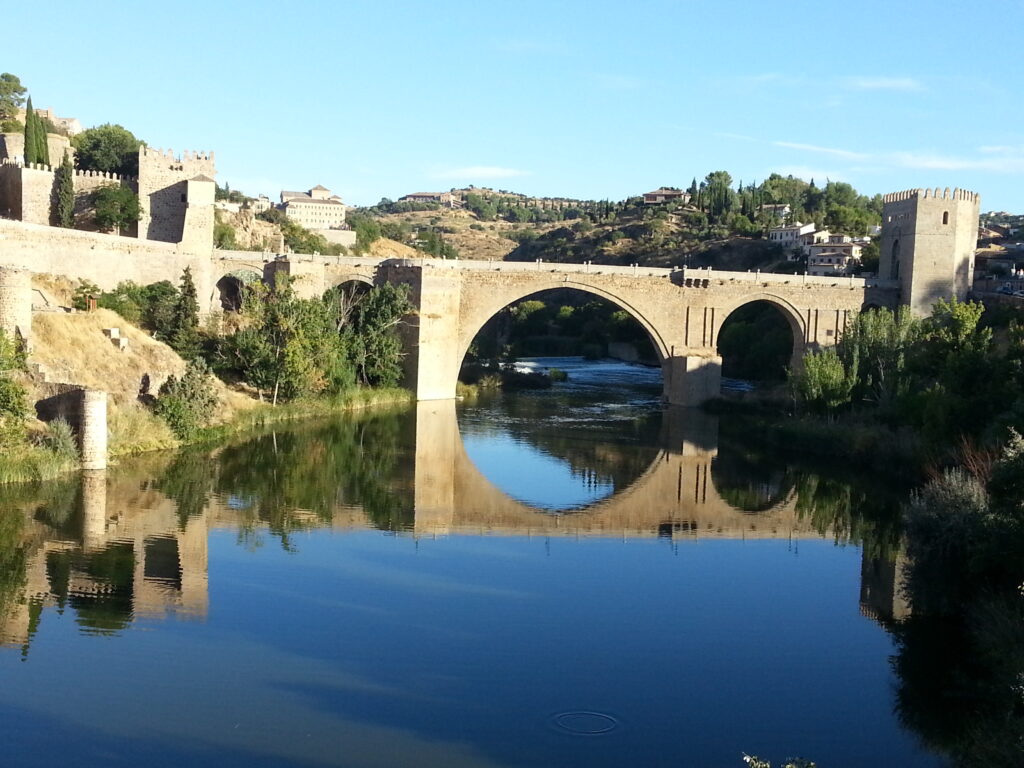
Toledo
Toledo is one of those towns where its picture-postcard beauty is replicated and enhanced in real life. It was built on a hill and as you approach the city from the plains below you can see the solid alcazar brooding over the narrow streets of the old town which huddle at its base. Impenetrable medieval walls with towers and turrets surround the town, apart from the along the parts where cliffs and ravines drop steeply to the Tagus river below.
Toledo was first a Roman city before it was taken over by the Moors who invaded most of the Iberian peninsula. During that period, Muslims, Jews and Christians co-existed peacefully side by side, exchanging cultures and traditions. After the Crusades this all changed and life for anybody that wasn’t Catholic became impossible during the cruel period of the Inquisition. Now a UNESCO World Heritage Site, the streets in Toledo are for the most part peaceful (if crowded) as throngs of tourists poke around the narrow streets, explore the cathedral, the mosques, the synagogues and the museums.
I took an open-top bus tour which went outside the walls offering fantastic views of the city walls and the portals and bridges from below. I looked around the shops selling souvenirs of knives and swords (Toledo was famous for its steel bladed weapons) and I ate rather too many marzipan sweets for which the city is also famous.
I stayed in a backpackers’ hostel in the centre of the old town and I was woken in the early hours of one morning by a group of men who were dressed in flamboyant costumes of capes and leggings and who were singing and playing in the street below. The following day I learnt that these are traditionally groups of students called ‘tunas’ who play for tips in the streets or at weddings. I was still unused to the all-night Spanish culture where it seems that anything goes and at any time, day or night, but it certainly added a bit of colour and noise to my visit.
Segovia.
I took a separate mini-excursion to Segovia on the bus from Madrid but this time I didn’t travel alone. I joined Valerie and her friend Guadaloupe. As I have explained before, one of the best things for me about travel is the people that I meet and the stories that I hear. I had met Valerie a few years before on a small group holiday with the travel company Explore when I went on a two week tour of Turkey.
Back then, Valerie was in Madrid attending an intensive Spanish language course. We met up first in Madrid for dinner and drinks and then we arranged to go to Segovia for a day, accompanied by her friend, I tend to not do too much homework about a place that I am to visit. I would rather have a surprise rather than feel that I know a place before I set foot there, and Segovia certainly delivered a huge surprise!
Walking towards the town from the bus station we turned a corner and I stopped dead in my tracks with my mouth wide open. Plonked right in front of us on and straddling the main street was a gigantic arched Roman aqueduct.
It has over 160 arches, stands a colossal twenty eight metres high and was constructed nearly 2000 years ago to bring water to the city from the mountains. Perhaps even more impressive are the precise, massive granite blocks that rely on balance and engineering to stand up without any mortar and it still functions as intended.
We also saw the beautiful fairytale alcazar (castle) which is reputed to be the inspiration for Disney’s Snow White castle with its towers and turrets and we had lunch in a traditional restaurant which served the local delicacy of ‘tostón or ‘cochinillo asado’ (which is golden suckling pig) and ‘ponche cake’. The piglets are tiny, never more than three weeks old, and are served up whole on individual plates. The cake consists of layers of custard and marzipan and topped with caramelized sugar.
Leaving Madrid
After my time in Madrid with Patricia, Roberto and Garban I had another first experience when I travelled north towards Tarragona, not on public transport but using a car share scheme.
I was a little bit nervous as I met the driver in a back street of Madrid but Bla Bla Car has a good system of reviews and vetting its users and I was determined to give it a try.
Roberto hung around with me whilst I waited for the driver to arrive just to check that everything was above board. It turned out that the driver/car owner was an ex-priest and apart from myself who would be a passenger as far as Zarragoza, two other people would be travelling with us and going further north.
It was a fun trip with three of us chatting as they all spoke excellent English and because we were all running a little late and I had a bus to catch in Zarragoza, Pedro asked the others if they would mind taking a little detour and dropping me right at the bus station. They all agreed and I caught my onward bus to Tarragona by the skin of my teeth.
Since then, I have used Bla Bla Car many times – both as a passenger and as a driver. It is a brilliant system which enables the car driver (who is taking a specific journey anyway) to have company and to receive a contribution towards the fuel and for the passengers for whom the journey is usually cheaper than public transport and is often much more flexible with regards to pick ups and drop offs.
If you have enjoyed reading this article you might like to read about a couple of my epic language fails for the price of a (very cheap) cup of coffee over at this link and sign up to make sure that you don’t miss the next article which will be coming out very soon.
If you would like to read about a couple of my embarrasing language fails then you can click on the link below which will take you to my Buy Me A Coffee site. https://buymeacoffee.com/scarletjonestravels/e/495262
What an amazing adventure you are having, experiencing so many beautiful things – sights, sounds, tastes and the swapping of hearts! Go Poppins! XXXXX
Would much rather have had the spoonful of sugar than the mouthful of pigs’ innards! The family life you found there sounds idyllic, how wonderful. I wish we could be like that but we get too stressed with kids, it’s a shame. Another ace experience to lock away and bring out to sigh over when you stop to breathe for a bit!
xx
It was a very special experience and I loved every minute of it. There is still huge importance placed on family life, meal times and conversation. Not to say that doesn’t happen in the UK of course but it does appear to be more ingrained in the culture in Spain.
Glad to hear your account once again and that you have met some lovely people. I have to point out that it is ColOmbia and not ColUmbia. Colombians get a bit tetchy about it, understandably.
Oops! Thank you for pointing that out. I will remember that one