Those words were supposed to comfort me, but I just wanted to pull the duvet tightly around me, snuggle deep into the wonderful bed and never surface again.
My adventure had begun. I had booked my coach to Heathrow and I was looking forward to my treat of a night at the Thistle Hotel where I had planned to enjoy a leisurely evening meal with a couple of glasses of wine, check out their roof terrace which overlooks the runway and Terminal 5 and experience their new Pod transfer system.
Instead of a fluttering of anticipation and excitement I began to feel quite queasy on the coach and before I even reached Heathrow, I was in the throes of a fully fledged vomiting bug. Somebody up there must have been looking out for me because at least I had one of the better coaches with a decent clean toilet. The bus deposited me at Terminal 5 and feeling dizzy and more light-headed by the minute I struggled with my backpack and my rucksack and staggered off to find to the Pod, the state-of-the-art transport system to my hotel.
the ‘station’
clean lines
I have to admit that when the hotel had phoned me to enquire whether I had heard of the Pod I thought that it was an expensive sounding gimmick, but boy, was I glad of it now. At the futuristic little station tucked away in Terminal 5 consoles rather than ticket officers waited, their screens glowing invitingly in the muted light, lined up alongside little docking stations behind a glass screen. As I followed the very simple instructions on the screen an unmanned electric cart trundled into view. Parking up next to the waiting business man standing at the next station I watched as he stepped in. My Pod was not far behind and I gratefully collapsed onto the wide seat, whilst a soothing recorded voice welcomed me to the experience and advised me to remain seated. Smoothly and almost silently we whizzed along a little roadway, up and down ramps and bridges, crossing over main roads packed with cars. The journey took just five minutes and I very quickly found myself in the car park of the Thistle. Check in was luckily speedy and hassle free, no doubt hastened by my very odd grey complexion as I just needed to get to my room and collapse in a heap.
So no nice meal or drink on the terrace. I couldn’t even take advantage of the tea and coffee making facilities in the room, but I did come very close to experiencing the on-call doctor. Luckily by four in the morning my symptoms had eased and I felt more confident about taking two consecutive flights and travelling for close on twenty four hours.
the pod
As I checked out, I was able to experience the Pod transfer system a little better. The little vehicles reminded me of some of the better bubble lifts at ski resorts, clean and nippy with stacks of room inside for up to four passengers and their bags. The station was just a short walk from the hotel reception and whilst marginally more expensive that the Heathrow Hotel Shuttle Bus, it was certainly worth the extra. I still come out in a cold sweat when I think how I was intending to catch the shuttle bus and I am not at all sure that I would have managed that journey.
Anyhow the day picked up and the adventure truly got under way.
The British Airways flight to Miami airport passed smoothly despite the American man to my left pointedly refusing to be drawn into any sort of conversation at all but he insisted on spilling over into my seat. The British man on my right did chat away but he also kept falling asleep and snuggling in against my shoulder.
Customs at Miami was more interesting. I had to go out through customs and then re-enter. It was very busy and at the head of my queue there were two men joking with each other about who was to go first. Well, the customs officer wasn’t having any nonsense at all and bounced out of his booth, got right into their faces and bawled at them, insisting that they tell him what was so funny. He really was quite menacing and was tapping his belt as if itching for them to give him an excuse for a good beating or a shooting. Torn between being nosy and trying to shrink down behind the man in front I really wished that I could have taken a photograph but that was a definite no-no. After my turn of being photographed and finger printed I automatically drifted forward to lean on the officer’s desk – and was promptly ordered in a very loud voice and in no uncertain terms to stand right back IMMEDIATELY. To lull me into a false sense of security, the official allowed the corners of his mouth to twitch in what was possibly a tiny smile, and when I responded with the same he yelled at me again – he was certainly revelling in his power and also managed to snigger at my passport photo too, but he did ‘ma’am’ me and wish me a good onward flight.
over Peru
There then followed an extremely boring seven hour wait at Miami for my next flight which would take me down to Lima in Peru. I have to admit to getting a little nervous at this stage, worrying about the imminent taxi ride and simply locating my hostel. A couple of airplanes later (they kept breaking) and three gate changes we boarded two hours late but had another uneventful five and a half hour flight to Lima. I managed to doze for most of it but woke to a magnificent sunrise whilst below the plane, the sharp jagged peaks of the Andes pierced the fluffy magicalness of the clouds, running all along the horizon on the left as far as the eye could see. I was momentarily confused as the captain announced that landing was imminent and the clouds were still far below us, but all became clear as we suddenly descended and landed in thick fog know as garua. Carmen, the dinky little Peruvian to my right explained that for much of the year. Lima is rather cruelly cloaked in a grey mist, not like any normal mist but one which bathes the city in a luminescent ghostly pale glow. It lifts briefly for a few short months during the summer and is due to do so any day now and when it does the people of Lima will rejoice
My adventure did not have the auspicious start that I had hoped and planned for but I will certainly not forget it and Sis was right – I am in the southern hemisphere, I am in South America and I can laugh about it now
Disclaimer: I received complimentary tickets for the Pod by the Thistle Hotel: but this did not, in any way influence my comments in this article, which are my own, personal views.
Whoop whoop! I am about to begin the next stage of my adventure.
In less that a week I shall be jetting off to Peru. The plan (Plan A of probably several) is to spend three nights exploring the capital Lima before heading up the coast to the second/third largest city that is Trujillo.
I have been warned to watch out for and avoid the hoards of pickpockets and bag snatchers who will be waiting for me in the arrivals hall, I have totally confused myself about which cab, bus or colectivo is the safest way to travel to my hostel and, oh dear, that reminds me, I don’t have a hostel booked yet either.
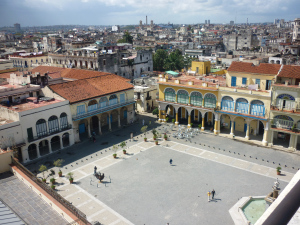
Havana
When I wake up in a cold sweat at three am I have to remember that I negotiated Havana by myself, and I call up images on Google to remind myself that Lima is quite the cosmopolitan city, not some Dickensian slum, albeit with a tendency for gatherings of riot police. I have decided to stop reading the guide books for now and just see for myself.
I have spent the last five weeks catching up with friends and family, sorting out mundane yet vital things such as backpackers insurance and I have had a lost filling replaced at the dentist. There are still a myriad of jobs to complete before I depart but I am not quite so stressed about them now.
I shall be spending my first three months in Peru working as a volunteer for an NGO (non-governmental organisation/charity), and then after that: who knows! Plan A (still) is to visit Machu Picchu, go see Lake Titicaca (that one is for my mum) and then explore South America whilst blogging and hopefully picking up travel writing commissions.
I need to write. I can’t think of any worst punishment that not being allowed to write, other than not being permitted to read. In my old life I had written sixty thousand words towards my novel and countless short stories and articles, most of which were shoved in the back of a drawer but since I have started out on my journey with Scarlet, I have become more focused.
Last weekend I accompanied my friend – herself a published author – to the Festival of Romance Book Festival. We stayed at a great Bed & Breakfast with a lovely host who cooked possibly the best full English that I have ever had in the Bedford Park Hotel, and I had some time to explore the market town of Bedford. I have never written romance in my life, but I was totally blown away by the people that I met and the camaraderie and support amongst the group of writers and readers. There was nobody at the event who underestimated the dedication and hard slog that it takes to get your words out there. After the awards ceremony I met some of the winners of the new talent awards who are about to realise their dreams and who have been awarded publishing deals. I saw agents and publishers supporting their prodigies and engaged with the whole host of writers who were networking and supporting each other. People described themselves in various ways; authors, writers, hybrid authors, self-published, bloggers or readers, to name just a few titles which were bandied around. When I talked to people I struggled to describe myself as I am just setting out on this journey, but then somebody else summed it up perfectly.
She described herself as a ‘new writer – not yet published’ – a description which I am more than happy to adopt. And I blog – therefore I am a blogger.
I shall go to Peru and I shall raise the profile of my alter-ego Scarlet Jones by reinstating my Twitter and Facebook sites. Attending the Festival has given me a timely nudge and it has reminded me why I resigned from my job, gave up my flat and left my life as I knew it
South American posts will take priority and I will update them frequently, sliding my European Adventure posts in amongst them.
So bear with me whilst I rebuild and launch Scarlet’s public face.
I am a new writer, not yet published and a travel blogger just setting out on the journey of a lifetime
Just one day after my week in France with the lads I was back at Stanstead airport and flying into Madrid. In this rewritten article from 2013 you will learn more about the Workaway scheme, meet the amazing family near Madrid and hear about some of my more epic language fails.
Senorio de Illescas is a dormitory town which lies bang in between Madrid and Toledo, just 35kms from either on a train or a bus and with the journey (in 2013) costing just an amazing two and a half euros. With my instructions clamped tightly in my hand I negotiated passport control at Madrid airport, the metro and then the Cercanias train system thanks to a lady who helped me with the ticket machine and who also advised me how to spot the pickpockets on the train from the airport.
The family who were to be my hosts had advertised on the Workaway website for a native English speaker to live in their home, speak English and to play with their adorable seven month old baby who I shall call Garbanzo (Spanish for something small like a tadpole or a chickpea).
After the structure of the work on the farm in Portugal where there was a specific (though flexible) timetable to follow, here there was no such structure. The timetable was dictated by Garban, but with his ready smiles and giggles that was no hardship.
I began writing this account of my experience in Madrid intending it to be factual and objective but as I left, heading north to Catalunya, it was hard to remain composed!
The family that I had lived with for three weeks took me into their home and into their hearts. I met both sets of parents, brother, sister, aunts and uncles, cousins and their amazing grandmother. We prepared meals together and swapped recipes, cycled, walked, shopped and chatted late into the night.
Patricia and Roberto were the ultimate hosts, tour guides and friends and there were tears all around as we said our goodbyes.
During my time with them, Garban sprouted two new teeth, he began to crawl and he started at his nursery. It was difficult to watch the pain on Roberto’s face as he walked away from his crying son leaving him with the nursery staff, and it brought back many memories of my children. I had yet to discover Mindfulness and I was navigating my own pain and heartbreak in the best way that I could, but what I was rapidly learning was that human connection and validation was healing me. As I crawled around on the floor with little Garban I was instinctively learning how to practice Mindfulness. I was determined to focus solely on him and his family. I immersed myself in the ‘Now’ and only later in my bedroom did I allow my thoughts to wander back to a different time.
tapas dish of pig’s ears
It was easy to love Garban and I loved every minute of my time in Illescas – even when I was challenged to eat tripe (pigs intestines). That challenge came about at a family birthday party. We were all seated around a large table in the courtyard when Patricia had to slip away for five minutes. As soon as the door closed behind her, her brother offered me the first plate to try, announcing with a mischievous gleam in his eye that it was his grandmother’s famous signature dish of `callos`. With ten pairs of eyes watching me, and the family holding their collective breath, I accepted some of the stew. I struggled gamely to chew and swallow, really not wanting to offend granny who was keenly waiting for my verdict but I regret to say that I failed miserably. I frantically looked for a napkin and then just as I was rising from the table to leave the room Mario presented me me with a bucket in which to spit! I was mortified but I really had no option. Patricia returned to hysterical laughter and as she took her seat besides me she whispered a warning – not to try her grandmother’s callos under any circumstances!
I felt honoured that despite many of the family not speaking any English they included me in the family birthday celebrations and with sign language and both Patricia and Roberto translating, I felt very much a part of things.
Patricia was enjoying the last two weeks of her maternity leave when I rocked up at their door, and then during my third week it was Roberto’s turn to take leave from work and to stay home while little Garbanzo began his gentle introduction to the nursery.
Both Roberto and Patricia had a very high standard of English and it made me determined to persevere with my Spanish lessons. Learning a language can be a tough challenge but I love to hear peoples’ stories and I was frustrated not to be able to communicate. Later on during my travels I would always attempt to learn the basics of each language as I changed countries, but it was much later after deciding to settle down in Spain that I made a concerted effort to learn Spanish (and the very different Catalan). I certainly never wanted to be one of those immigrants who can just about order a coffee and I am proud that now I can for the most part understand and be understood. If you want to read about a couple of my epic language fails, CLICK HERE , and for the price of a cup of coffee you can find out how I dropped my trousers in front of a physiotherapist and how, in a separate incident I traumatised a Spanish farmer!!
Anyway, apart from the family party what exactly did I get up to in Spain? For a start, no two days were ever the same.
sleepy tigers
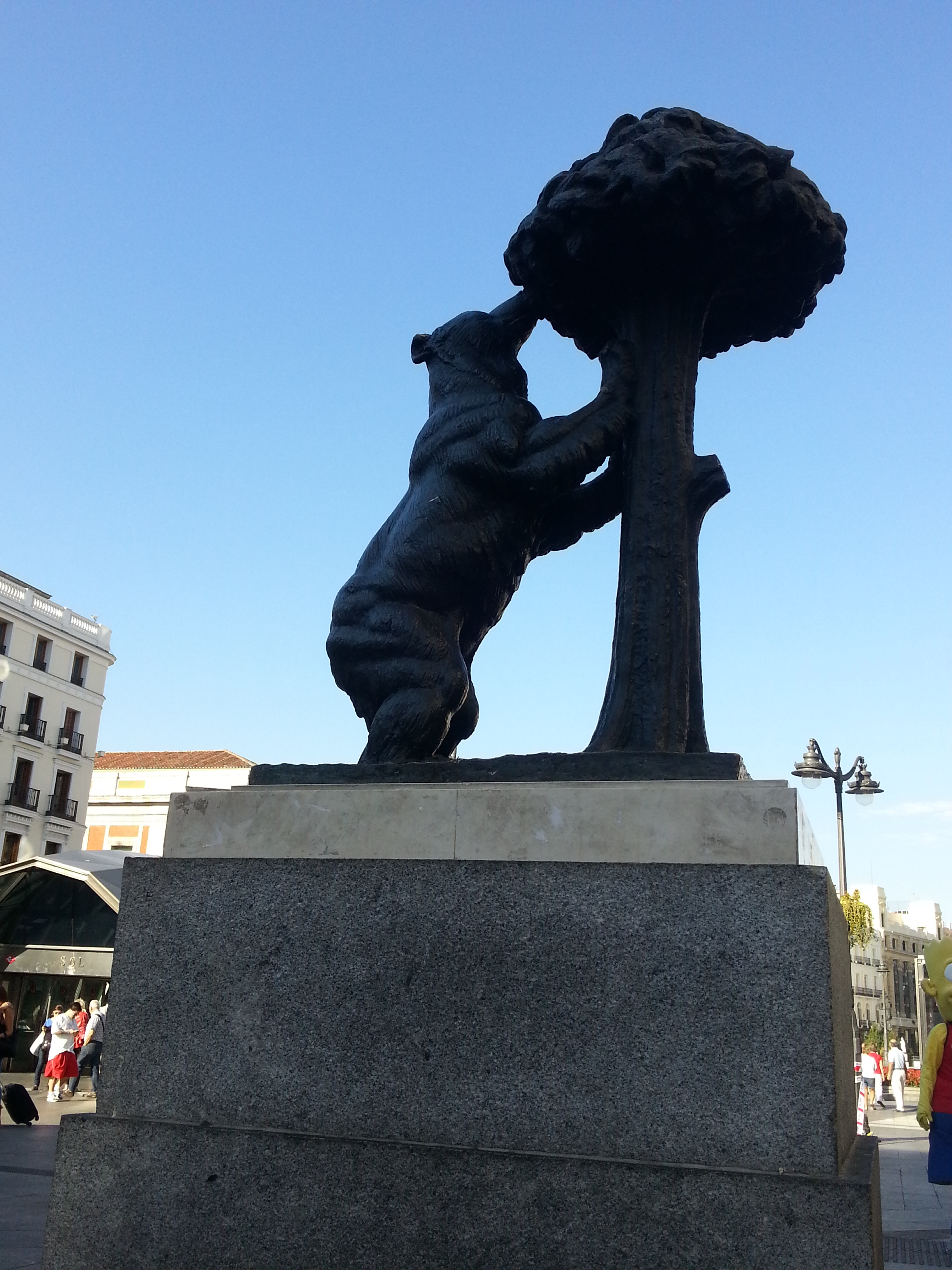
To begin with, I learnt about the Spanish routines and way of life. Each day would begin and I would usually entertain the baby and chat to Patricia over breakfast. Garban was only seven months old and not talking, however research has shown that if a tiny baby is exposed to different languages they will find it much easier to pick them up later and to speak with the correct accent if spoken to by someone of that mother tongue; which was why I was there living with the family. Patricia and I would often go out for a walk with the pram, go to the shops or to the weekly market which was set up in the shadow of the futuristic looking bull ring. On one of our walks we came across a big trailer containing a couple of sleepy tigers They were not a permanent feature of the town but they were a part of a travelling circus which was in town. Several times we went out for beer or a coke and tapas in a bar and as the temperature was a toasty thirty-plus degrees for the majority of my stay, I would often lay in the garden on a sun lounger or dip in and out of the little pool.
I very quickly learned how the Spanish (generally) take their time over meals and prioritise their friends and family. Lunch would be served as late as 15:30 or even at 16:00hrs, followed by a light dinner at about 22:00hrs. There was very little ultra-processed food eaten or even available to buy (although that is sadly beginning to change) and a gazpacho was prepared from scratch just about every day using the stale bread left over from the previous day’s dinner. Roberto would bring a fresh baguette (barra) home every day with him, always broken at the table with hands not cut with a knife and a snack could be a small canned tin of sardines eaten straight from the can rather than a packet of potato crisps. There was no quick clearing away of plates after dinner and settling down on the sofa to watch TV. Life in Spain generally revolves around the family chatting together and it seems to be totally unrushed. It is still very very normal to see groups of neighbours outside their houses and apartments in Spain in the evenings sitting on little plastic chairs and simply spending time together rather than shut away in their individual houses. During the hot summer months the play parks are alive with children playing and running around while their parents stand and chat at MIDNIGHT! That one certainly took some getting used to, although now, after many years of living in Spain I rarely eat my dinner before 21:30 and I am very used to getting dressed to go out to a party or to watch a music band at midnight.
Garban was totally doted on by his entire extended family and I never once witnessed any irritation or impatience with him. If he couldn’t sleep then not to worry, it just meant more time with him. If he refused to eat, no matter, still more time with him. Perhaps because of the devotion that he received, he had little need to cry or grumble and he was always ready with his smiles and cuddles. He was showered with affection and it always made me laugh when either set of grand parents arrived and the battle to cuddle and hold him began! He was so content and happy to be with me and this is when I earned the nickname of Mary Poppins.
I have since learnt that this obsession with babies is the norm in Spain where children are generally adored and included in every event. There is rarely any need for a babysitter here because to include children is such a big part of the culture and society. If you go into a bar or a restaurant you will often see small children playing with their dolls or toy cars in the corner under a table or little ones fast asleep in pushchairs oblivious to the noise around them. I am convinced that this is one of the reasons why so many Spanish children grow up uninhibited around adults and why and how all age groups tend to mingle at the bigger events. It’s not uncommon to see teenage boys entertaining smaller children or dancing with their grannies. Unlike in the UK where it would be very un-cool and most teenagers wouldn’t be seen dead playing with a four year old in front of their friends, here in Spain it continues to be the way of life.
Aside from being with the family and with encouragement and plenty of hints and tips from Patricia and Roberto I also set off on some mini-adventures of my own and I went off and I explored Toledo, Madrid and Sergovia.
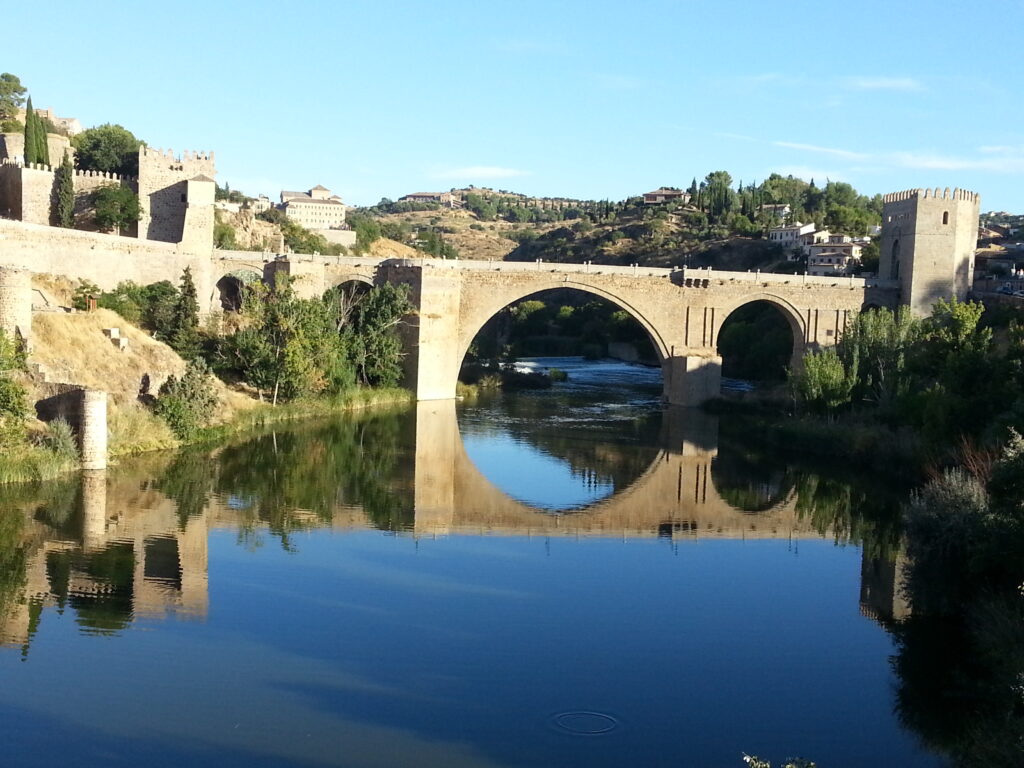
Toledo from the river
Toledo
Toledo is one of those towns where its picture-postcard beauty is replicated and enhanced in real life. It was built on a hill and as you approach the city from the plains below you can see the solid alcazar brooding over the narrow streets of the old town which huddle at its base. Impenetrable medieval walls with towers and turrets surround the town, apart from the along the parts where cliffs and ravines drop steeply to the Tagus river below.
Toledo was first a Roman city before it was taken over by the Moors who invaded most of the Iberian peninsula. During that period, Muslims, Jews and Christians co-existed peacefully side by side, exchanging cultures and traditions. After the Crusades this all changed and life for anybody that wasn’t Catholic became impossible during the cruel period of the Inquisition. Now a UNESCO World Heritage Site, the streets in Toledo are for the most part peaceful (if crowded) as throngs of tourists poke around the narrow streets, explore the cathedral, the mosques, the synagogues and the museums.
I took an open-top bus tour which went outside the walls offering fantastic views of the city walls and the portals and bridges from below. I looked around the shops selling souvenirs of knives and swords (Toledo was famous for its steel bladed weapons) and I ate rather too many marzipan sweets for which the city is also famous.
I stayed in a backpackers’ hostel in the centre of the old town and I was woken in the early hours of one morning by a group of men who were dressed in flamboyant costumes of capes and leggings and who were singing and playing in the street below. The following day I learnt that these are traditionally groups of students called ‘tunas’ who play for tips in the streets or at weddings. I was still unused to the all-night Spanish culture where it seems that anything goes and at any time, day or night, but it certainly added a bit of colour and noise to my visit.
Segovia.
I took a separate mini-excursion to Segovia on the bus from Madrid but this time I didn’t travel alone. I joined Valerie and her friend Guadaloupe. As I have explained before, one of the best things for me about travel is the people that I meet and the stories that I hear. I had met Valerie a few years before on a small group holiday with the travel company Explore when I went on a two week tour of Turkey.
ø;
Back then, Valerie was in Madrid attending an intensive Spanish language course. We met up first in Madrid for dinner and drinks and then we arranged to go to Segovia for a day, accompanied by her friend, I tend to not do too much homework about a place that I am to visit. I would rather have a surprise rather than feel that I know a place before I set foot there, and Segovia certainly delivered a huge surprise!
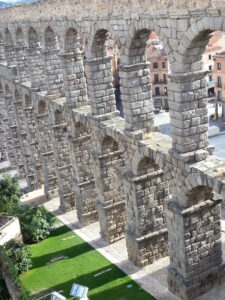
Walking towards the town from the bus station we turned a corner and I stopped dead in my tracks with my mouth wide open. Plonked right in front of us on and straddling the main street was a gigantic arched Roman aqueduct.
It has over 160 arches, stands a colossal twenty eight metres high and was constructed nearly 2000 years ago to bring water to the city from the mountains. Perhaps even more impressive are the precise, massive granite blocks that rely on balance and engineering to stand up without any mortar and it still functions as intended.
We also saw the beautiful fairytale alcazar (castle) which is reputed to be the inspiration for Disney’s Snow White castle with its towers and turrets and we had lunch in a traditional restaurant which served the local delicacy of ‘tostón or ‘cochinillo asado’ (which is golden suckling pig) and ‘ponche cake’. The piglets are tiny, never more than three weeks old, and are served up whole on individual plates. The cake consists of layers of custard and marzipan and topped with caramelized sugar.
Leaving Madrid
After my time in Madrid with Patricia, Roberto and Garban I had another first experience when I travelled north towards Tarragona, not on public transport but using a car share scheme.
I was a little bit nervous as I met the driver in a back street of Madrid but Bla Bla Car has a good system of reviews and vetting its users and I was determined to give it a try.
Roberto hung around with me whilst I waited for the driver to arrive just to check that everything was above board. It turned out that the driver/car owner was an ex-priest and apart from myself who would be a passenger as far as Zarragoza, two other people would be travelling with us and going further north.
It was a fun trip with three of us chatting as they all spoke excellent English and because we were all running a little late and I had a bus to catch in Zarragoza, Pedro asked the others if they would mind taking a little detour and dropping me right at the bus station. They all agreed and I caught my onward bus to Tarragona by the skin of my teeth.
Since then, I have used Bla Bla Car many times – both as a passenger and as a driver. It is a brilliant system which enables the car driver (who is taking a specific journey anyway) to have company and to receive a contribution towards the fuel and for the passengers for whom the journey is usually cheaper than public transport and is often much more flexible with regards to pick ups and drop offs.
If you have enjoyed reading this article you might like to read about a couple of my epic language fails for the price of a (very cheap) cup of coffee over at this link and sign up to make sure that you don’t miss the next article which will be coming out very soon.
If you would like to read about a couple of my embarrasing language fails then you can click on the link below which will take you to my Buy Me A Coffee site. https://buymeacoffee.com/scarletjonestravels/e/495262
We arrived in Lagos for our break from the work exchange scheme but finding our room for the night took on a whole new direction when deep inside the labyrinthine back streets and alleys which make up Lagos’ old town, my friend´s mobile died. We had been making our way to our reserved room navigating by GPS, when suddenly it spluttered and went dead. Luckily, and because I don’t always trust technology I had jotted down the address just before the phone gasped its last. I vaguely remembered from the map that the street ran parallel to the old town walls, so with a lot of luck we ended up in the right street.
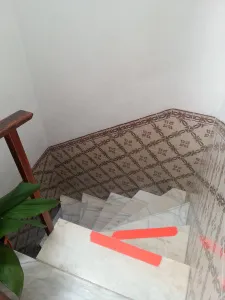
Knocking at number 22 we were met by Maria, a diminutive lady who spoke no English at all, however she shepherded us to a house a couple of doors down the street. That front door opened into a tiny little room with the steepest narrowest staircase that I have ever seen outside of a medieval castle, and she led us up to some tiny rooms on the third floor, which included an en-suite bathroom and a narrow balcony.
We met the occupant of the room below us as we set out to explore! She hadn’t been as lucky as us and her bathroom led directly off the landing! We met her as she was cleaning her teeth. There was actually no room for her to stand and clean her teeth and shut the door at the same time. The only way around it (I suspect) was that she should sit on the loo but who knows; maybe there wasn’t even the space for that!
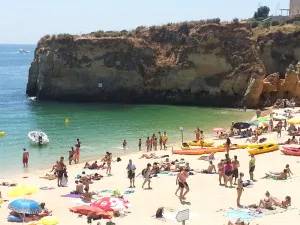
We then set out to do some exploring and ended up at the bottom of some steep rocky steps in a tiny little bay where we did some sunbathing and swimming.
Praia de Batata
This tiny little bay was the epitome of the Algarve with its golden rocky outcrops and sandy cliffs and caves. Lagos itself had a lovely feel to it – it was busy but not overly so, touristy but had an attitude about it that it didn’t give a stuff what you thought – you could take it or leave it – and it was full of tiny little craft shops selling some very tasteful products
The usual leaflets and tourist information had been left in our room and one entry caught our eye. The Nah Nah Bah reputedly served what had been voted one of the top 50 burgers in the world and as my friend and I were both partial to a PROPER burger we decided to check it out. Just a few streets away from us and located in backpacker hostel-land (Lagos old town), the Nah Nah Bah was bursting at the seams. We certainly didn’t mind waiting so settled down on bar stools for some rather splendid mojitos and watched the action.
There were a few small tables at the back, but the majority of customers were seated at long trestle tables. Reggae blasted from the DJ’s box in the corner and large portraits of Bob Marley and Che Guevara peered down on diners from the walls. We were soon sandwiched between a family from the UK and a couple of backpackers from Australia and settled down to order our burgers. I am pleased to report that the meal did not disappoint and it was so perfect that we actually returned the following week just to check that it hadn’t been a fluke.
Fully satisfied we set off to find out what bars and night life Lagos had to offer and we were not disappointed there either. Several bars and far too many mojitos later I climbed the windy staircase on my hands and knees and feeling like an over-sized Alice who had eaten the cake labelled ‘eat me’, I crawled into the miniature room when I had a perfect night’s alcohol-fueled sleep.
Death stairs
The next day we visited the old Slave Market following a recommendation from a friend. This was in a small building with an even smaller exhibition (small appeared to be the theme in Lagos) but despite its simplicity, the exhibition was very moving as it described the horrific slave trade from Africa to the sugar and tobacco plantations in the Caribbean.
Back at the farm we continued working on the land and swimming in the eco-pool. We were also asked by Willem to sand and then oil the ends of the beams which held up the roof of their amazing house. Well, get me – I am afraid of heights but I was up and down the ladder with my brush and only a little bit nervous. My new approach to life at that time was to stop being such a pussy and just get on and try things which would serve me well when things were a little trickier in South America.
For our final night, Sol cooked us an amazing meal of black pork which we ate as the sun went down and we then all sat chatting until late into the night. To start the meal, we had chorizo which she cooked at the table on a little terracotta dish with flaming alcohol, grilling it slowly. Listening to the frogs and watching the stars, we didn’t want to leave, but the adventure had to continue and the next day we got the coach back to Lisbon. My friend and I parted company as I was now heading to Spain. My plane was delayed and eventually took off just three minutes under the time when I could qualify for compensation under the European rules. But eventually I was on the way to my next destination – this time all by myself. Finally I would starting my adventure proper and I would be travelling solo.
This article was rewritten and updated in February 2025. It seems that the Nah Nah Bah is still trading and I would love to know if it still has the same awesome vibe as it did ten years ago. Let me know if you have visited it more recently and if the burgers are still worth of their prize. I really hope so.
If you would like to support my writings and musings you can head over on this link and buy me a coffee ( at Spanish prices)
‘We shwim with the nature here. If you would like to shwim with the nature too with no clothes on then that is all right by us’. Those rather worrying words were spoken by our host who had just picked us up in his car from the side of a deserted lane in the middle of nowhere. He had introduced himself as Willem and he was driving us to his farm and what was going to be our home for the next two weeks. I didn’t dare look at my friend as I felt sure that I would have a fit of the giggles and I didn’t want to offend our host at this early stage of the game.
Earlier that morning we had set out from Lisbon on the intercity coach to Lagos and then caught a local bus to Bensafrim. I was a little worried because we didn’t have an address for our destination. Apparently rural addresses in Portugal can be problematic and our bus driver had no idea where our stop was either despite it appearing on the timetable. We were left on a grass verge in the middle of nowhere and hoped that we could get a mobile signal so that we could contact our hosts or we would be stuffed!
Luck was on our side and Willem soon appeared in his car. He was large, loud and Dutch and we joined him in the car to be bounced down dusty tracks to his farm where we were introduced to his wife Sol who was quiet, petite and Portuguese.
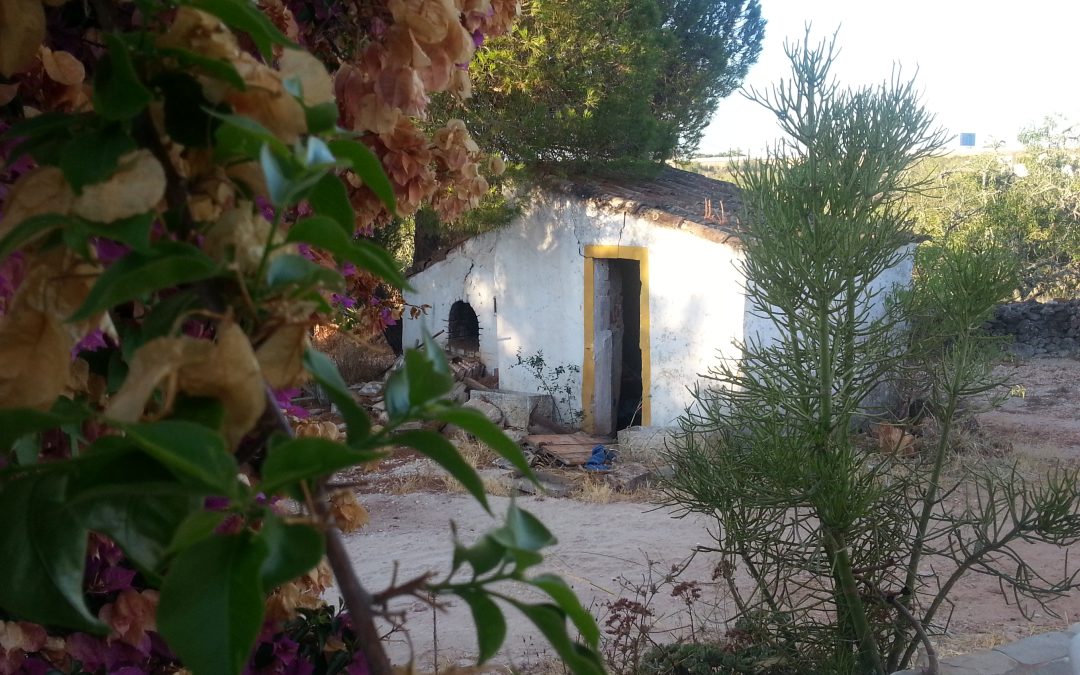
We were given one of the cottages on their farm which was spacious and cool and whilst it was sparsely furnished, it was perfectly adequate. It had been empty for a while but my friend was a darling and swept out the majority of the cobwebs and their occupants before we unpacked.
Willem then gave us a tour of his land which consisted of several large fields, a dozen chickens, and a handful of holiday cottages which are rented out to tourists. There was also a swimming pool but this was no ordinary swimming pool. It was an eco-pool which meant that it had no chlorine or chemicals in it and it was cleaned by nature i.e. frogs, newts and water lilies. Willem reiterated that guests often like to swim naked in the pool and if we chose to also ‘feel free’ at quiet times that would be fine with them. It´s so funny how things change because now I regularly visit a nudist beach where I even stand at the bar with no clothes on or have a massage totally naked but back then I wasn´t quite so daring. You can go to this link if you would like to know how a series of personal challenges to myself led me to end up on a beach with no clothes on!
Their home in the main house was stunning; all high ceilings and beams and windows and light. Sol is a designer and had worked wonders on their home as well as on the other cottages with innovative colour schemes and mosaic tile displays.
We were here as volunteers on a work exchange scheme. The deal was that we should each work 25 hours across seven days in exchange for bed and board. This is the standard as recommended for this sort of scheme with Workaway although they do vary from placement to placement. In our case, Willem and Sol would provide the ingredients for meals which we would prepare ourselves although they would sometimes invite us to eat with them. That first evening we joined them on their terrace to a lovely lamb casserole; the second evening we cooked for ourselves but I was given a plate of freshly grilled sardines hot off the coals. My friend dipped out as he doesn’t eat fish and received nothing.
After oversleeping the next morning and hurriedly reporting for work at 11am our first jobs were to weed the large pebbled perimeter path of the pool and to cut down the waist high grasses from the bank. We weeded and scythed and then we raked the cuttings down into the field.
Our next task was to clear the algae from the pond. There was very little but it had to come out and Willem demonstrated his well established technique for dealing with it. It floated hazily where it had been blown down one end of the pool but it was deceiving in its mass. The trick was to insert a finger into the water and gently stir in a circular motion. Like stirring a cloud the translucent substance would wind around your finger and gather there like candy floss and then it could be pulled out of the water. Where it had caught around the stems of the water plants you could carefully comb it out through your fingers. There was the continuous chirripping sound from the frogs that hopped and plopped into the water loudly every few minutes which sounded like birds, not like frogs at all, but very musical and which brought to mind the Paul McCartney song the Frog Chorus.
swimming with frogs
Day two and we creaked out of bed following all the physical work the previous day. We managed to wake earlier so that we could work in the cooler hours and were first asked to weed a large flower bed. Sol loved her flowers and colours but the wild boar had recently got into the beds and ripped up some of her plants. We weeded for several hours until we disturbed an ants nest and I got several nasty nips on my toes whilst my friend was happy to finally establish the difference between a plant and a weed and proudly announced that ‘if it came up easily it was a plant’.
Willem and Sol had three adorable dogs who appeared to have adopted us and spent all their time following us around or lazing under the enormous bougainvillea tree on our terrace. There was a small simple bar just fifteen minutes down the hillside in the village although it took twenty five minutes to haul ourselves back up to our cottage after a couple of drinks; but when three pints of the local beer and three VERY large wines cost less than seven euros it would be rude not to wander down. The second time that we went down to the bar the four locals who were sitting on the terrace and watching the world go by shared their bar snacks with us. No idea what they were – sort of like giant salty sweet corn kernels but very nice too and it felt good to be accepted as a part of the gang despite the language barrier.
We spent the third day in the vegetable garden;, weeding between waist high rows of corn, pruning olive trees and preparing a raised bed to plant out lettuce seedlings. I did intend to plant the seedlings out in the cool of the evening but we got home too squiffy to tackle that delicate task!
Over the next couple of days I planted out those eighty baby lettuce plants and we pruned the olive branches. We also double-dug (is that word?) a raised bed in preparation for sweet potatoes and there was more sitting in the waist deep water at the edge of the pool in my bikini to clean the algae.
And then….we had achieved our twenty five hours so we could take the rest of the afternoon off. And the following day we set off early to catch the local bus to Lagos for a well deserved break.
This article was first published in August 2013 but has been updated as I re-tell my story of living a nomadic lifestyle
We were very lucky to find accommodation in an AirBnB with Guida in her apartment in Lisbon. She lived just ten minutes walk from the Optimus Alive Music Festival venue but she provided us with much more than just beds for the night.
Before we got down to the business in hand and went to the festival we spent a day and a half exploring Lisbon thanks to Guida’s help and guidance.
Guida provided us with food for breakfast every day, she helped us to book our onward tickets to Lagos (because the website was in Portuguese), she took us on a quick guided tour of her neighbourhood and she got us cheap bus passes. She also printed out our tickets at her local library and even drove us to the bus station at 7.45am on her day off.
There was just one funny incident which was when she first showed us around and she asked us to make sure that we kept the bathroom door closed as her cat would get in. Guida was very vague about what the cat might do and I just assumed the cat would probably drink from the toilet – but we found out the next morning because I had accidentally left the door ajar in the middle of the night. I was first one up and in the bathroom and it turned out that the cat preferred to use the bidet rather than her litter tray. There, curled up in the bowl of the bidet was one very smelly, very large poo! Oops!!
Exploring Lisbon
On that first afternoon in Lisbon after a siesta we got a tram back into town and we walked up the steep hill to the Castelo de Sant Jorge. The views across the city from the ramparts were amazing although we arrived at the Tower of Ulysses just five minutes after they had closed off visitor access to the periscope. The camara obscura is an optical system of lenses and mirrors which had been invented by Leonardo da Vinci and I had actually seen one in action in Havana, Cuba. The castle is quite big with complete walls and seven towers to climb, and then as we wandered down the hill from the castle, we found a cute little rooftop bar with a sun terrace that overlooked the terracotta roof tiles of the city below.
Lisbon streets
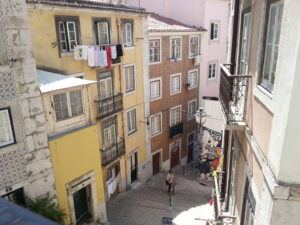
We then wandered around tiny narrow streets in the Amalfa district on the hillside which consisted of steep steps and cobbles. Coloured garlands criss-crossed the washing lines that were strung between the balconies, children played in the gutters, and most of the houses were faced with painted ceramic tiles.
These tiles are common all over Lisbon and they lift common looking buildings into works of art. We then stumbled upon a ‘World Fair’ in a large square where we sat and drank caipirnhas from the Brazilian stall and listened to Latin American music whilst watching the Lisboans promenade past us in the park. That evening we ate in a tiny restaurant where I had the most delicate grilled sea bream that you could wish for and we also struck gold with our tram ride home when for the late night journey, the sleek modern tram had been replaced by one of the original bone-rattling wooden trams.
On Saturday morning we walked to the Belem area and visited the Torre de Belem (Tower of Belem), we wandered along the waterfront to the Padreo dos Descobrimentos (Monument to the Discoveries), we chatted with a Marine who was guarding the war memorial (more about him later), we poked our noses inside the Mosteiro dos Jeronimos (Jeronimos Monastery) and find of finds, had coffee and the most exquisite pasteis at the famous Cafe de Pasteis.
Guida had recommended that we shouldn’t miss this little treasure and we were so glad that we found it. Reminiscent of a tearoom in times gone by there were little ante rooms off from the main hall and we were served by waiters who glided silently around the rooms with their pretty tiled walls. As well as the opulent surroundings those pasteis were quite a little bit delicious and actually, as it turned out, quite famous.
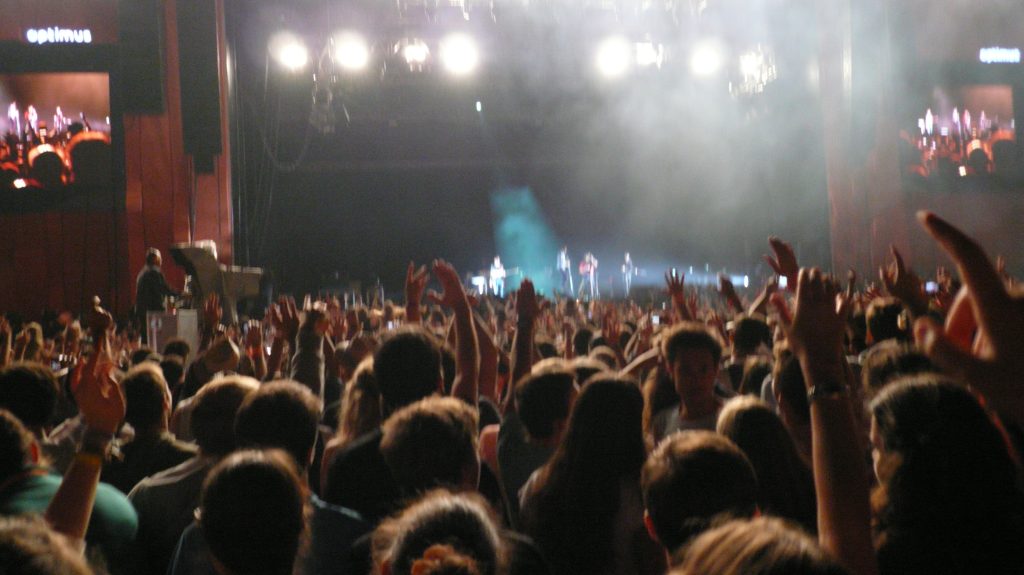
The Optimus Live Music Festival
After a couple of very pleasant days sightseeing it was time to go to the festival.
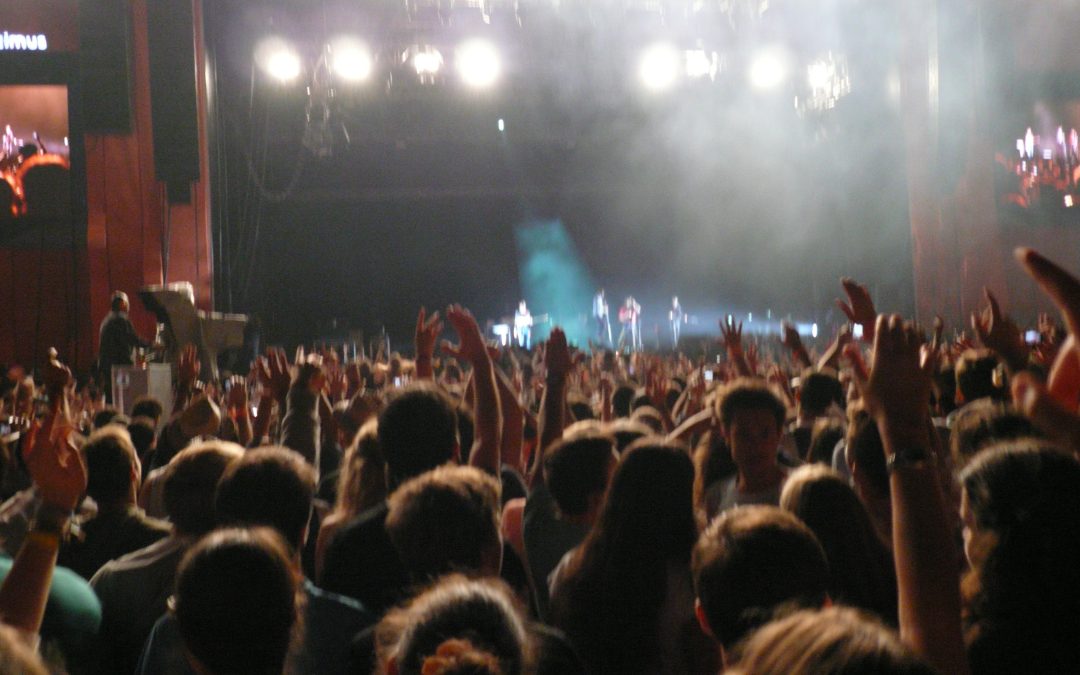
I had never been to a music festival before, after having a bad experience involving a near riot with Dexys Midnight Runners (who remembers them?) when I was aged sixteen when they performed at the Top Rank night club in Cardiff. Since then I have always been wary around crowds and I had actively avoided concerts or gigs for most of my life. I wasn’t involved in the fracas in Cardiff but I had been just an innocent teenager who was caught up in the middle of a large mob who were out to cause trouble. Once some guys in the crowd turned violent and began throwing beer bottles at the band on stage, the police were called and it turned very quickly into something like the Wild West. I just wanted to escape from the cave like venue but I was trapped with all hell breaking out around me. The band left the stage and then when the police arrived the gangs turned on each other and a huge fist fight broke out.
Anyhow, I digress. This trip was all about finding myself and becoming confident so I decided to bite the bullet and go to a music festival – and after all, this destination was the winning ticket in my lottery to decide where to begin my travels so it was like fate was guiding me; which was how I ended up in Lisbon with tickets to the Optimus Alive Festival.
Queuing in the sun was relaxed with people from across Europe waiting in line. It was good fun trying to work out the language and the nationality of people but it was even more fun eavesdropping on people trying to chat each other up, with English as their second but common language.
Festival Highlights
Optimus Alive Festival, Portugal
I had never heard of the band Of Monsters and Men and because they didn’t have one of the headline slots and were performing in the ‘unknown’ tent I thought that it would be safe to get a place quite near the stage; however by the end of their set the tent was packed and people were standing outside right back to the food stalls. I think that their popularity took many people by surprise but the word soon went around that this wasn’t a band to be missed, and they continue to be a band that I listen to today.
Greenday were the headliners on the first day and as they had been one of my son’s favourite bands I knew most of their music. They gave a terrific live performance, as did The Kings of Leon – although with both bands I was careful to stay back, well away from the crazy mosh pit.
The Stereophonics also played as well as Biffy Clyro, Depeche Mode and the Brass Wires Orchestra and many others.
There wasn’t a huge choice of food but there were food trucks where we discovered a great Portuguese dish called ‘tachadinha porco’ which was spicy pork pieces served with onions, sauce and rather bizarrely tiny sticks of crisps in a bun. We also ate a lot of ‘farturas’ which are best described as giant churros which were served piping hot, rolled in cinnamon and sugar. For just one euro and eaten hot they provided the perfect energy rush.
To top everything off a LARGE tumbler of very decent red wine could be bought for just two euros. Maybe it’s not cool to drink wine at festivals but hey, when in Europe…! By the end of the festival I had hardly any anxiety – due in part to the relaxed atmosphere and the fact that so many people weren’t focusing on drinking but only wanted a good time in the sun with good music and their friends.
I didn’t see any trouble or anti-social behaviour as I would have expected but the majority of Spanish and Portuguese have a very different approach to alcohol compared to large number of Brits on an evening out.
I felt very pleased and proud of myself that I had faced my fears and I had been in large crowds for two days running but now it was time to say goodbye to Guida (although our paths would cross again) and time to take that bus south towards the Algarve where we were booked to do some volunteer work on an eco-farm and hostel.
A Portuguese Marine’s perspective on life.
Before the next article in which will tell you about our time in the Algarve I would like to tell you about our encounter with the Marine that I mentioned above.
It’s probably not a story that most people would bother including when they recount their holiday memories however I find people’s stories and opinions as interesting, if not more so that ticking off the top ten of places to visit.
In this instance, when we stopped to chat with Juan who was a guard at the war memorial we got a real insight into what a soldier thought of politics and customs.
It can do us all good to listen to another person’s view on one’s own country. All too often we can be quick to dismiss our heritage and we may grumble about our politicians and our way of life, or we might look the other way and assume that what we grew up with is superior to someone else’s experience in another part of the world. Sometimes it takes a foreigner to highlight what they believe to be bad in their country and to point out how your own might be so much better – but at the end of the day we don’t need to agree or to argue, but to keep an open mind and ask questions.
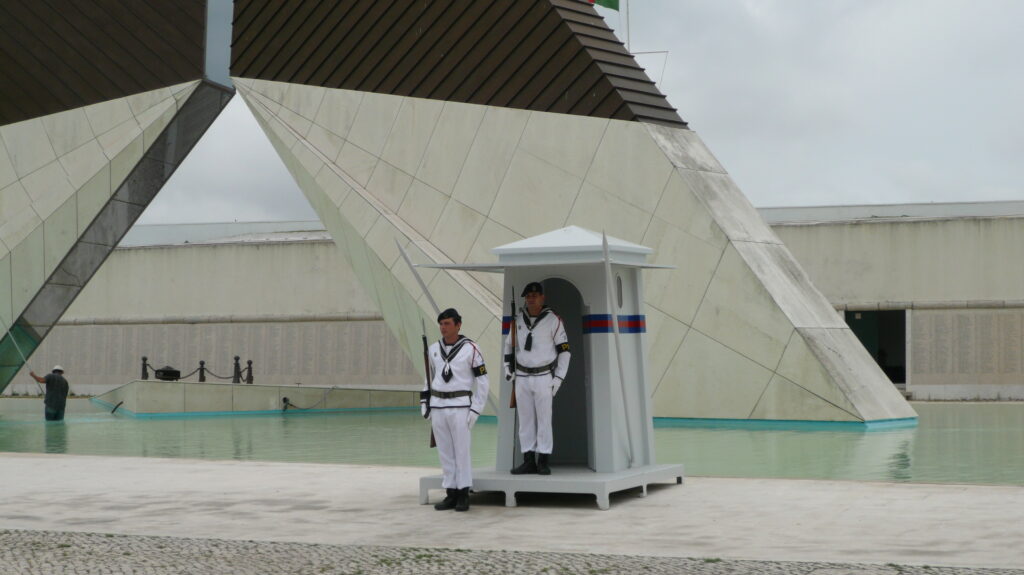
We had been walking along the seafront from Alges to Belem when we passed a large war memorial and we happened upon the changing of the guard. We stood to watch the ceremony and after the retiring guards had moved away, the sailor (I assumed) who was now ensconced in his guard box, beckoned me over and indicated that I should have my photo taken with him. I teased him that he would get into trouble as in the UK the guards were supposed to stand very still and be serious but keen to break the monotony of his day he proceeded to chat with us for the next twenty minutes.
His name was Juan and he was a Marine. The Marines are a relatively young branch of the Portuguese services and were set up when a small group of their armed forces came to the UK to train and to learn how our Marines functioned. Juan had served in Somalia and Afghanistan and he was now serving a period of time on ceremonial guard duty in front of the war memorial. Whilst he believed that it was correct to have a guard present he also felt that it was an activity beneath the esteemed Marines. The large marble walls listed many fallen Portuguese with the majority of the deaths taking place during the 1960’s in the Portuguese colonies in Africa. There were thousands of lives lost in Mozambique and Portuguese Guinea during that decade.
Juan was trying to come to a decision. He had just about served his initial eight years in the Marines and was being pressured into signing up for a further term. He praised the British system and society for its forward thinking and appreciation of the role of its service personnel.
Like Britain, Portugal does not have compulsory national service, but unlike Britain it doesn’t allow its military personnel to sign up in chunks of time which may or may not be extended or opted out of (or at least it wasn’t an option when we met Juan.) Having served eight years he could now either leave or sign up and remain in the service until he was sixty five. He had enormous respect and pride for his country but he couldn’t begin to imagine how his politicians could consider an elite member of the forces would be able to continue until that age. He wanted to remain in the services, but not until he was that old, and he was therefore looking to terminate his career and return to university.
He was also full of praise for the British people and their support and pride in their troops. Juan explained that in Portugal the population generally considered people who went into the armed forces or the police to be civil servants and they refused to acknowledge their part in wars on the world stage such as in Afghanistan. He was so pleased to be able to thank me and BF for our pride in our armed forces (we are British therefore it was a given) and by proxy, our acknowledgment of his work.
Juan continued to highlight the differences between the decisions that the leaders of the two different countries had made when deciding to enter the European Union and choosing whether to adopt the Euro. He believed that both past and present British governments were fiercely protective of their rights, the currency and were strong and correct to stand up to the German Chancellor, whereas the Portuguese governments had given away too many rights and privileges in the past and now the population were paying for it. He was scathing about the German prime minister and her attitude towards the poorer nations in the EU and he could understand why so many young people wanted to leave his country and work abroad.
Politics aside, I am extremely proud of our armed forces in the UK and this was reinforced listening to Juan. We may have many things wrong in the UK but things are not always as rosy as they appear elsewhere and this was highlighted to me that day on the seafront in Lisbon.
If you have enjoyed reading this, please sign up (for free) over at my Buy me a Coffee page where you can see more of the articles like this one and you can read them in the order that they are published.









 His name was Juan and he was a Marine. The Marines are a relatively young branch of the Portuguese services and were set up when a small group of their armed forces came to the UK to train and to learn how our Marines functioned. Juan had served in Somalia and Afghanistan and he was now serving a period of time on ceremonial guard duty in front of the war memorial. Whilst he believed that it was correct to have a guard present he also felt that it was an activity beneath the esteemed Marines. The large marble walls listed many fallen Portuguese with the majority of the deaths taking place during the 1960’s in the Portuguese colonies in Africa. There were thousands of lives lost in Mozambique and Portuguese Guinea during that decade.